
The Philosophical Shift Behind Complementarian Thought: From Plato to Aristotle
How Greek philosophical thought influenced biblical interpretation

Cultural Backdrop of the Early and Medieval Church
One might expect the further you go back in history the more traditional values dominate but history is not linear in that way. The early Church was surprisingly equitable in their church offices as we continue to find out. I highlighted a few instances of female bishops in a prior post. Yet by the time we get to the medieval church, we have quite a different landscape. By that time, the cultural inheritance was evident. Common sayings and common law reflected a common belief that women were ontologically inferior. This wasn’t due to a theological predisposition but rather a philosophical and traditional one. Beyond scripture itself, the writings of Plato and Aristotle dominated the writings of the early church fathers and medieval theologians.1 They swam in the waters of Greek philosophy. While the early church struggled against Greek philosophies of a Demi-urge complimented by Marcion, they were simultaneously employing it to support trinitarian beliefs. Because Koine Greek was the lingua franca of the day, it further entrenched speakers into philosophical traditions unknowingly. The one Greek whose thought dominated early church writings was none other than Plato.
Platonic Philosophy
Although the early Church fathers were Christian in religion, they couldn’t be unwound from the dominant philosophy of their day. They received a Hebraic religion but interpreted it through a Greek paradigm. I don’t wish to perpetuate older theories of scholars who wished to paint Paul as a Platonist. He and his contemporaries, as inheritors of the Christian faith, were very much Jewish in their theological understandings concerning God and the world, but very much spoke, thought, and argued in Greek ways. Though not a Platonist, Paul did hail from Tarsus which rivaled Athens and Alexandria in Greek philosophy by the 1st century BCE.2
It’s clear that some of those Greek philosophical concepts seep through Paul’s writings at times while he maintains a thoroughly Jewish theology. He seems to conceptually be drawing on Plato’s Cave in writings like those to the Colossians. In reference to their celebratory festivals he says they are “…a shadow of things to come.” And yet he maintains Christian theology situating those shadows in the “reality of Christ” (v. 17). Concerning Plato’s ontological treatment of the male and female disposition, he’s strikingly fair. Because of Plato’s dualistic philosophy, he believed that differences amounted to that of physical limitations and not much else. In reference to their civic duties and capabilities he suggests “…women in the guardian class must receive the same education as men, and perform the same duties… for their nature is the same as that of men in respect of guardianship.”3 He reasons that they are similar in capabilities and responsibilities, “…for the soul is the same in both sexes, and the difference is only in bodily strength.”4 Peter is well within the strain of Platonic thought when he makes mention of women being the “weaker vessel” (1 Peter 3:7). Plato would still probably considered a misogynist by today’s standards, but he certainly establishes philosophical foundations for egalitarian thought.
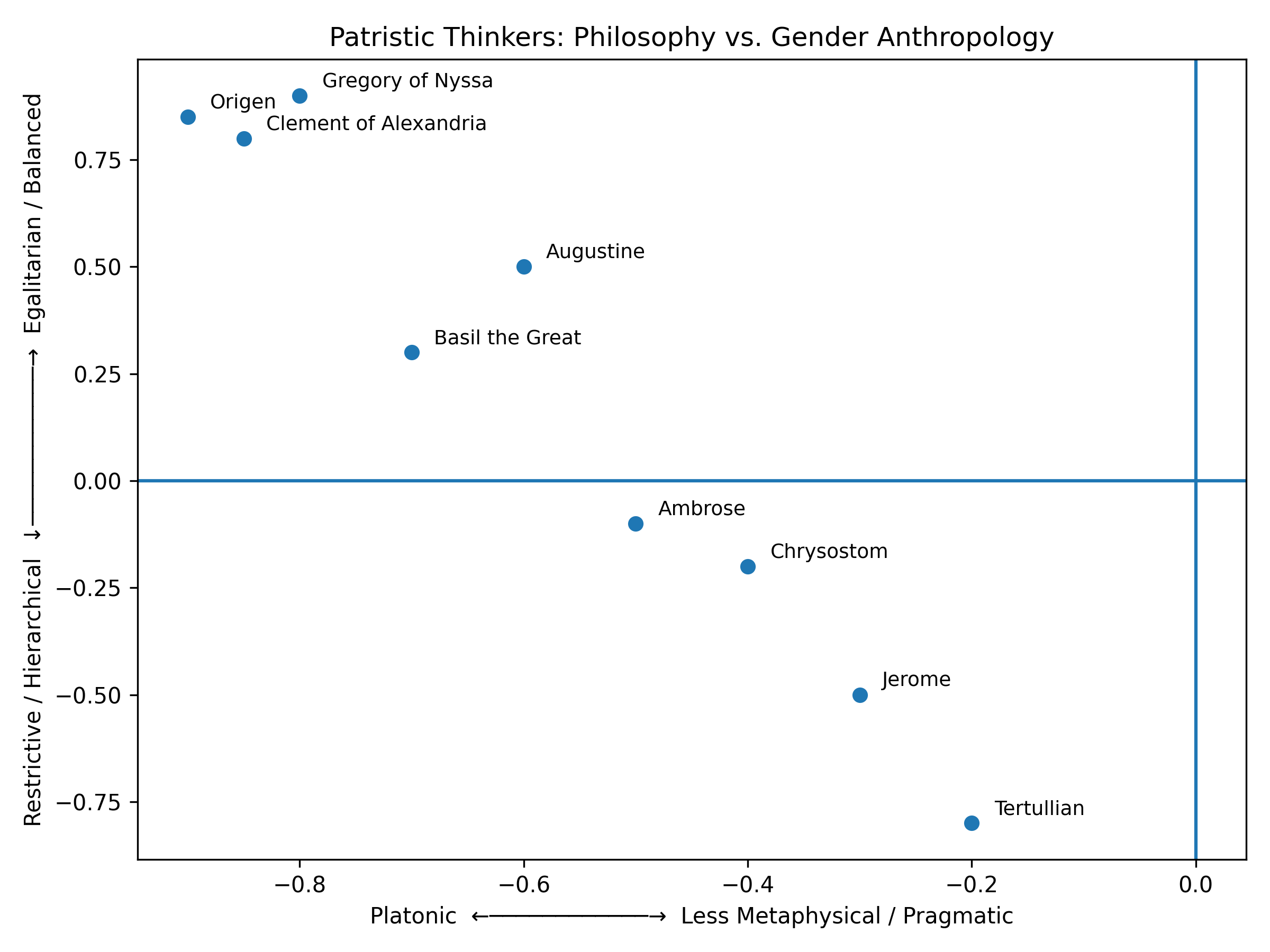
In more explicit and plentiful ways, the early Church fathers continued to draw on Plato to fill out their ontological treatises concerning males and females. Drawing on the Republic and Timaeus, Clement of Alexandria writes, “For virtue is common to all rational souls, and the mind, the soul’s guiding principle, is not divided by sex.”5 In the same stream writes Origen, “The soul is neither male nor female; it is fashioned in the image of God. Therefore, both men and women alike may attain knowledge and virtue, though their bodies differ in strength.”6 It seems at least corollary that because Platonic thought was THE philosophy of the early church fathers, misogyny was the minority position when compared to later medieval theologians. But when Plato becomes less influential, hierarchical assumptions prevail. Here’s a graph to demonstrate.7
In Comes Aristotle
As Platonic thought waned and Aristotelian thought grew, so did misogynistic tendencies within Christian writings. There’s certainly correlation, and within certain theologies we can also trace causation. The reason? While Plato emphasized how natural law was representative of metaphysical realities, Aristotle rooted natural law in biological realities. Aristotle maintains and reiterates, “Again, the male is by nature superior, and the female inferior; and the one rules, and the other is ruled; this principle, of necessity, extends to all mankind.”8 Although a student of Plato, he was also influenced by Hippocrates (think Hippocratic oath) who was a physician that lived a generation prior to Aristotle. Hippocrates rationalized sociological hierarchy via his biological explorations. He notes that in prenatal development, “The male is generated from the hotter and firmer seed; the female is generated when the heat is deficient, and the seed is weakened.”9
The 12th and 13th century saw boons in scientific curiosity and exploration that gave rise to the Renaissance. Universities began sprouting up and theology became a scholastic science. Major works were now being translated like those of Aristotle. Within this movement, Aristotle offered something that Plato could not: an explanatory framework rooted in biological realities that could further drive inquiry. As Aristotelian thought came to prominence among medieval theologians, so did his anthropology concerning female inferiority. This is most demonstrated within the works of Thomas Aquinas, whose influence on Christian thought can’t be overstated. Because he is arguably the most influential theologian of the Medieval period and perhaps even of modernity, his use of Aristotelian thought burdened his hermeneutic and provided a firm foundation for future complementarian thought.
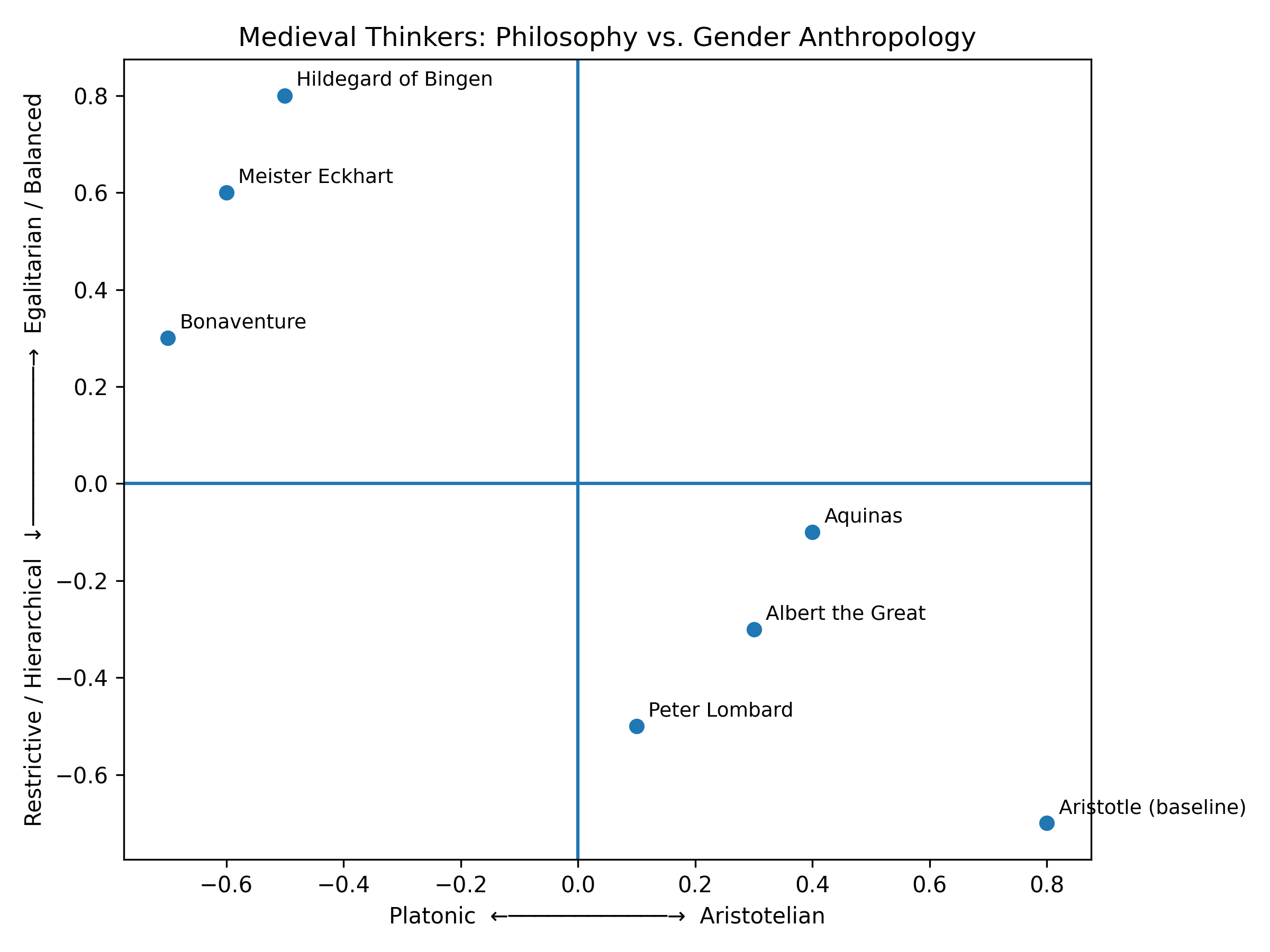
Aquinas makes frequent usage of Aristotle. Most of the time, he merely refers to him as “the philosopher.” This should give us clarity on just how prevalent Aristotle was during this time. Aquinas, in his treatise on The Production of Woman, raises the hypothetical objection, "It would seem that the woman should not have been made in the first production of things. For the Philosopher says (De Gener. ii, 3), that ‘the female is a misbegotten male.’ But nothing misbegotten or defective should have been in the first production of things. Therefore woman should not have been made at that first production.”10 In reply to this objection he states the following: “As regards the individual nature, woman is defective and misbegotten, for the active force in the male seed tends to the production of a perfect likeness in the masculine sex; while the production of woman comes from defect in the active force or from some material indisposition, or even from some external influence; such as that of a south wind, which is moist, as the Philosopher observes (De Gener. Animal. iv, 2).”11 Note how we see hints of Hippocrates in this as well. What we see through Aquinas’ writings, as well as other Medieval theologians, is less equitable readings concerning the sexes when Aristotle’s influence abounds. Here’s another graph to demonstrate that point.12
The Main Point
On the other side of criticisms concerning logos theories and painting Paul as a Platonist was an over-correction that displaced early and later theologians from their cultural milieu. For better or for worse, Greek philosophy dominated the writings of the early church fathers and later medieval theologians. Where Platonic thought loomed, more equitable readings of the text were formulated. Where Aristotelian philosophy reigned, less equitable readings arose. This helps to paint a more checkered, non-linear picture concerning egalitarian/complementarian readings of the text of Scripture. While certain traditions emphasize the historic, univocal nature of complementarian readings and church governance, that interpretation seems less ubiquitous when the evidence is examined. Many of our most influential theologians who were complementarian were so because of the misogynistic nature of Aristotelian thought that infiltrated their hermeneutics over “plain readings” of the text. And IF complementarian readings were the norm, it seems more evident that we have Aristotle to thank more than we do Paul.
See Henry Chadwick, Early Christian Thought and the Classical Tradition
Strabo, Geographica (Book 14, section 13)
Plato, Republic 451d–452a.
Plato, Laws, Book VI (771b–772a)
Clement, Paedagogus 3.4
De Principiis 2.11.1–2
This visualization is a heuristic synthesis of patristic anthropologies based on comparative textual analysis and secondary scholarship; axes represent relative tendencies rather than quantitative measures.
Aristotle, Politics, I, v
Hippocrates, On the Nature of the Child
Aquinas, Summa Theologica, Part I, Q92.
Ibid.
This visualization is a heuristic synthesis of medieval anthropologies based on comparative textual analysis and secondary scholarship; axes represent relative tendencies rather than quantitative measures.
Fascinating. Thank you for this! I recently made the argument that complementarianism has distanced itself from the outright patriarchy of Aristotle, but does so by leaning on a Platonism that values the equality of invisible souls while subjugating the agency of physical bodies. Would love to hear your thoughts! https://open.substack.com/pub/renewedmind/p/mythbusters-christianity-has-always?r=1tpvzu&utm_medium=ios&shareImageVariant=overlay